

BRAAP SCOTLAND • MOTORCYCLE TRIALS GUIDE
A rider rolls into a rocky section, touches one boot down and rides out. The observer calls “one”. The next rider gets through without putting a foot down: “clean”. But why can a failed section earn five marks, and why is there no four? Here is how motorcycle trials scoring works at Scottish club events, in plain English.

The quick answer: lowest marks wins
Motorcycle trials is a test of balance, grip and precise bike control, not a race to the finish line. Each rider attempts short marked sections, often several times over successive laps. Penalty marks are added when the rider needs support or fails to negotiate a section correctly. In ordinary observed trials scoring, the rider with the fewest marks lost wins their class or route.
The scores you will hear: 0, 1, 2, 3 and 5
- 0 — Clean. The section is completed correctly without a penalty.
- 1 — One mark lost. Usually one dab: the rider puts a foot down for support.
- 2 — Two marks lost. Usually two separate dabs or other counted supports.
- 3 — Three marks lost. Three or more dabs/supports while still completing the section; the normal footing penalty is capped at three.
- 5 — A failed section. For example, going outside the designated route, not completing the section or another failure defined by the event's rules.
There is no four-mark observation score in this standard system. Specific failures, stopping rules and time penalties depend on the regulations for the event.
What counts as a dab?
A dab is when a rider uses a foot to support or steady the motorcycle in a section. The first dab usually costs one mark, the second costs another, and three or more cost three in total. Other physical support — for example leaning on something to stay upright — can also attract marks under the applicable rules.
A clean is therefore not necessarily the fastest or flashiest ride. Someone who calmly selects a good line and keeps both feet on the pegs can beat a rider who attacks the obstacle much faster but has to paddle through.
What is an observed section?
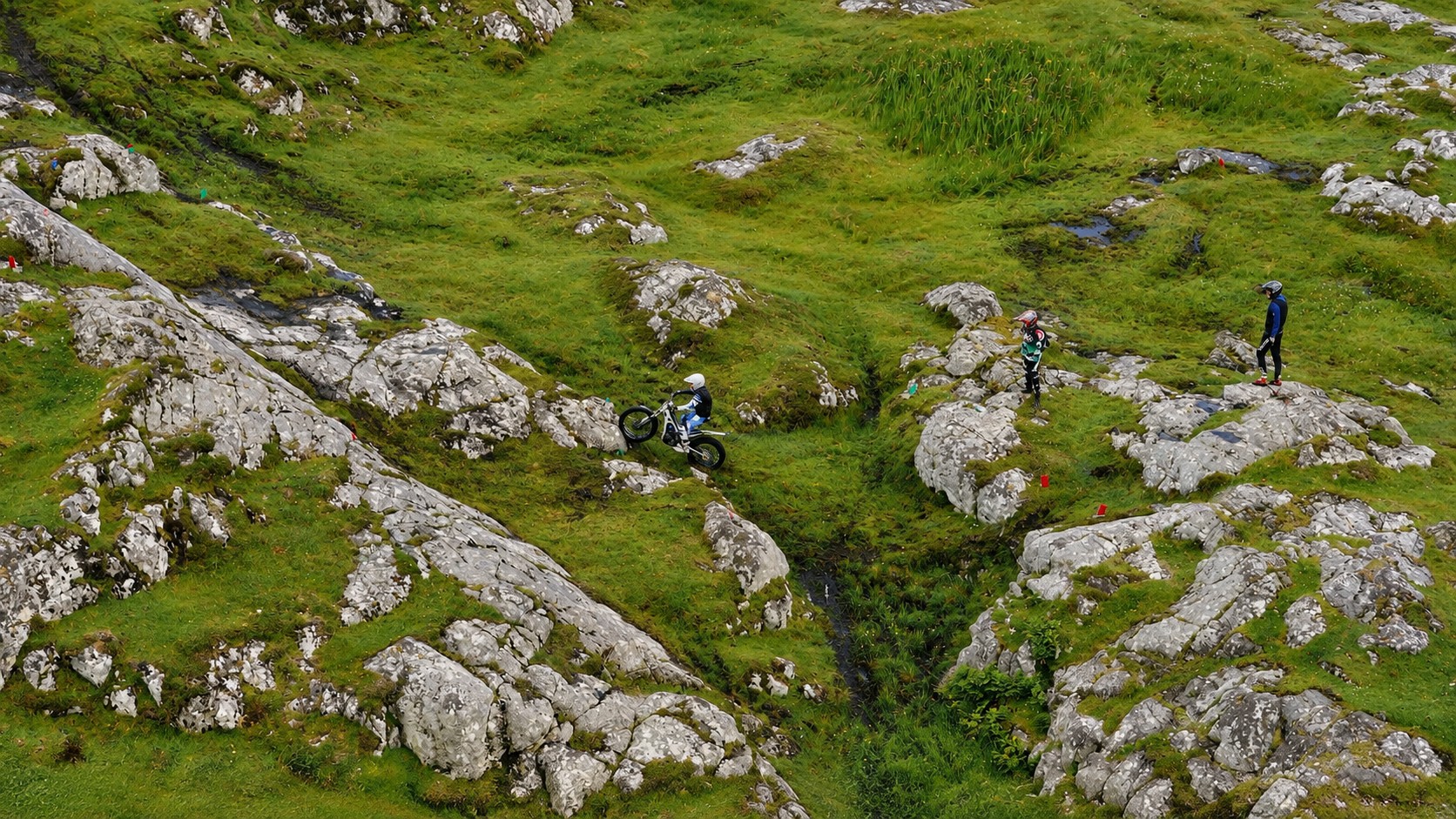
At a Scottish motorcycle trial, a section is a short route between clearly identified entry and exit markers. It might include a steep bank, stream bed, tight turns, muddy roots or a rocky step. The rider has to follow the correct markers for their route and stay within the section rules.
Between the sections is a linking route or lap. That part gets competitors around the venue; it is not normally where the observed marks are awarded. A club trial might have several numbered sections repeated over several laps, but the number, order and time allowance depend on the organiser.
An observer watches each attempt and records the marks lost. At some club events the scoring can instead use rider cards or an agreed group-scoring arrangement. The club's instructions take priority, so find out how cards are marked or punched before setting off.
How are the marks added up? A simple example
Imagine a club trial with four sections and two laps. One rider's first lap scores are 0, 1, 3 and 5: that is nine marks lost. On the second lap they score 0, 0, 1 and 2: another three marks. Their total is 12 marks lost. A rider on the same route and in the same class who finishes on eight marks has the better score.
This is why one poor section does not automatically spoil the day. A five hurts, but a clean on the next attempt still matters. Results may also consider event-specific time limits, missed sections or tie-break rules: read the organiser's regulations rather than assuming every trial uses exactly the same system.
When does a rider get five marks?
A five is commonly called a five or a failure. Typical reasons include missing a required marker, leaving the section, failing to complete an attempt, or breaching the applicable rules about stopping or support. These are examples, not a substitute for the official failure definitions used by your event.
Does stopping count as a five?
Many Scottish club trials use non-stop observation, where maintaining forward motion matters. Under those rules, stopping can result in a five. Trials events and championships do not all use identical observation rules, however, and what counts as stopping is decided under the event's current regulations. Check the club's supplementary regulations and listen to the riders' briefing; do not rely on what you saw at a different trial.
Why are there different routes and classes?
Not everyone has to tackle the same obstacle at the same difficulty. Clubs often mark easier and harder lines through a section so beginners, youth riders, experienced competitors and riders on different types of machines can enjoy the event. You may see A and B routes, Clubman lines or other named and colour-coded options. The flag colours and names are not universal.
An easier route is not cheating; it is how a trial becomes accessible. A newcomer should ask the organising club which route fits their ability and machine rather than copying a more experienced rider's choice. Results are generally compared within the relevant class or route, not across every rider at the venue.


Your first Scottish trials event: what to do
- Find a suitable club. Use BRAAP's Scottish trials club and venue directory and ask about beginner routes, introductory sessions or the chance to watch first.
- Check the event details. Browse the Scottish trials calendar, then confirm the current entry arrangements, licence or registration requirements, location and start time with the organiser.
- Understand the course. At sign-on, ask which route markers you follow, how many laps and sections to complete, how scores are recorded and how to sign off at the finish.
- Ride your own level. Watch other riders, take your time between sections, respect observers and stay on the permitted route. A safe, steady three is more useful than attempting a line that is beyond your current ability.
Still weighing up the cost? BRAAP has a separate guide to starting motorcycle trials in Scotland without overspending. If you are completely new to off-road bikes, start with the broader Scottish motorcycle trials guide.
Watch a real Scottish trials rider
The scoring makes more sense once you see the balance and concentration involved. In this BRAAP Scotland rider story, Ashleigh Davison talks about fifteen years in motorcycle trials and what keeps her riding. It is a rider story rather than a scoring demonstration, but it shows the people behind the sport.
Watch Ashleigh's rider story on BRAAP's YouTube channel or read the full BRAAP rider-story page.
Motorcycle trials scoring: common questions
Why are there 0, 1, 2, 3 and 5 marks, but no 4?
In the usual observation system, dabs and counted supports rise to a maximum of three marks. A separate five-mark score is used for a failed section. Four is not a normal section score.
Do you have to complete a trial as quickly as possible?
Normally, no. The aim is to keep observed marks low, not ride the sections fastest. Some events have an overall time allowance or other timing rules, so check the final instructions.
Can I enter a Scottish trial if I have never competed?
Potentially, yes. Many clubs offer accessible routes or beginner-friendly activities, but not every meeting is suitable for a first event. Ask the organiser about classes, equipment, insurance, licence or registration and whether a practice or coaching day would be a better start.
Can I watch a trial before entering?
Watching is often a useful first step, provided spectators are permitted. A lot of Scottish trials take place on private land made available specifically for the event. Contact the organiser about access, parking and safe viewing points; do not assume an event venue is open for casual riding or unrestricted spectating.
Official rules always come first
This is a beginner explanation of common observed-trials scoring, not the regulations for a particular championship. For the event you plan to ride, check the Scottish Auto Cycle Union trials information, the organiser's supplementary regulations and any current rule amendments. Loch Lomond MCC's 2026 trials regulations page is one example of a club that makes governing rules available. East Neuk Wobblers' club explainer also sets out the common 0–1–2–3–5 scoring in practical terms.
YOUR NEXT STEP
Find a trial, meet a club, see the sport for yourself.
Once you understand what a clean, a dab and a five mean, watching an event becomes a different experience. Start with a local club and the next suitable trials date.
